This Belgian/Netherlands magazine just reviewed our 3 new releases : MARTINA VERHOEVEN & ANTON MOBIN – Cure And Mound, JOHN EDWARDS & DIRK SERRIES – Melancholia and TOM JACKSON & COLIN WEBSTER – The Other Lies. Still available from our store and bandcamp.
“Weer of geen weer, er is altijd de onvermoeibare Dirk Serries. Of het nu een reeks nieuwe albums betreft op zijn eigen label New Wave Of Jazz of nieuw werk, al dan niet solo, op andere labels, hij is er altijd. Gelukkig hoeven we door de diversiteit niet te zeggen dat we te veel nieuw werk van hem horen. Op ‘Melancholia’ gaat hij in duet met contrabassist John Edwards, een heerschap met een indrukwekkende carrière als het jazz in al zijn vormen betreft. Geïmproviseerd meestal, extreem bij momenten, is Edwards, die we leerden kennen toen hij in Gent kwam spelen met zijn legendarische B-Shops For The Poor en God (met onder meer Kevin Martin), nog steeds zeer actief. Het hoeft allemaal niet meer zo gewelddadig en luid, getuige ook deze samenwerking. Gitaar en contrabas, meer hoeft het niet te zijn. Deel één begint behoorlijk heftig maar stilaan kiest het duo voor rustiger vaarwater eenmaal ze de bombast hebben verkend. Edwards met strijkstok en Serries lekker tokkelend voelen ze elkaar heel goed aan en wordt ‘Melancholia’ een leuke luisterervaring en geen plaatje waarop twee virtuozen hun kunnen willen bewijzen. Dat kunnen is namelijk ondergeschikt aan het luisteren naar elkaar en het brengen van luisterplezier aan wie zijn grenzen wenst te verleggen. Serries leerde doorheen zijn muzikale loopbaan heel wat muzikanten kennen. Een deel ervan brengt met veel plezier werk uit op zijn label. De Fransman Anton Mobin bijvoorbeeld, die zijn prepared chamber inzet om tegenwerk te bieden tegen het pianospel van Martina Verhoeven, gade van Serries. Verhoeven gaat soms woest te keer, soms zeemzoet, hard en zacht, terwijl Mobin allerlei geluiden uit zijn bewerkte houten kist haalt waarin allerlei spielerei uitnodigt voor zijn uitgebreide improvisatietalent. Hij maakte, meestal in duo, sinds 2006 een quasi ontelbaar aantal albums. Deze keer gaan ze voor twee lange stukken, het ene bijna drie kwartier, het andere net geen half uur. Door de afwisseling van klanken blijft de set boeien en dat is wel bijzonder bij dit soort improv waarbij heel wat geproduceerde klanken al snel op de zenuwen zouden kunnen werken maar door de gedrevenheid van het duo dat niet doen. Het duo van klarinettist Tom Jackson en saxofonist (alt en bariton) Colin Webster is een behoorlijke uitdaging. Zes improvisaties die ze maakten in februari 2021 die laten horen hoe afwisselend hun beider instrumenten kunnen klinken en op elkaar inspelen. Geen ruw geweld, wel deugddoende luisteroefeningen voor gevorderden die geen probleem hebben met wat gepiep en gekraak.”
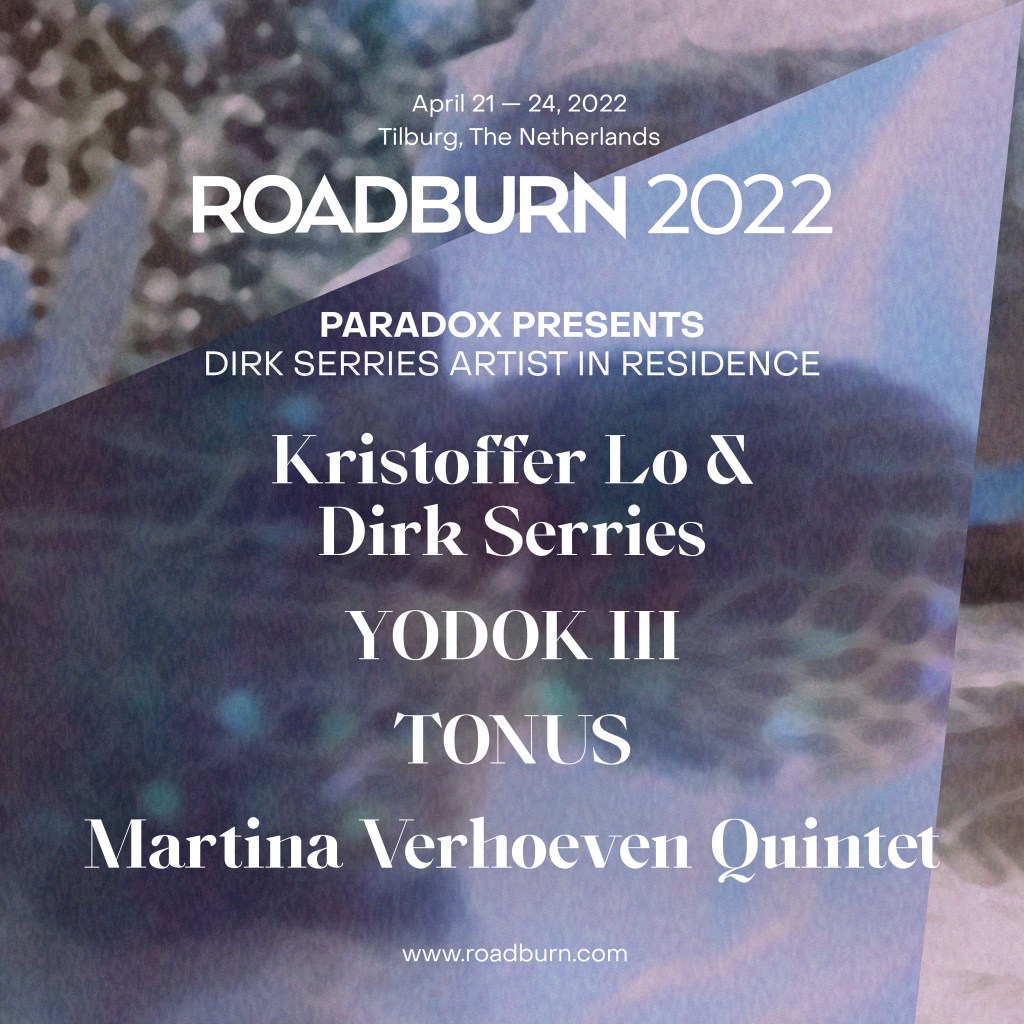
A New Wave Of Jazz’s curator DIRK SERRIES receives an unique opportunity from the magnificent ROADBURN FESTIVAL in conjunction with jazzclub PARADOX in Tilburg to exhibit during the 4 days of this festival what he has been creating over these 38 years in experimental, avantgarde, electronic and free-improvised music.
APRIL 21. The first performance will see Dirk team up with fellow YODOK III member, Kristoffer Lo. Having previously collaborated separately with the ‘other’ third of the band, Tomas Järmyr for The Void of Expansion, it was surely only a matter of time before this pairing would come together too. Dirk will play the electric guitar, whilst Kristoffer will perform with an amplified tuba and flugabone, turning their instinctive passion for melancholic, cycling harmonies into an ambient drone requiem that will mesmerise with its utter beauty.
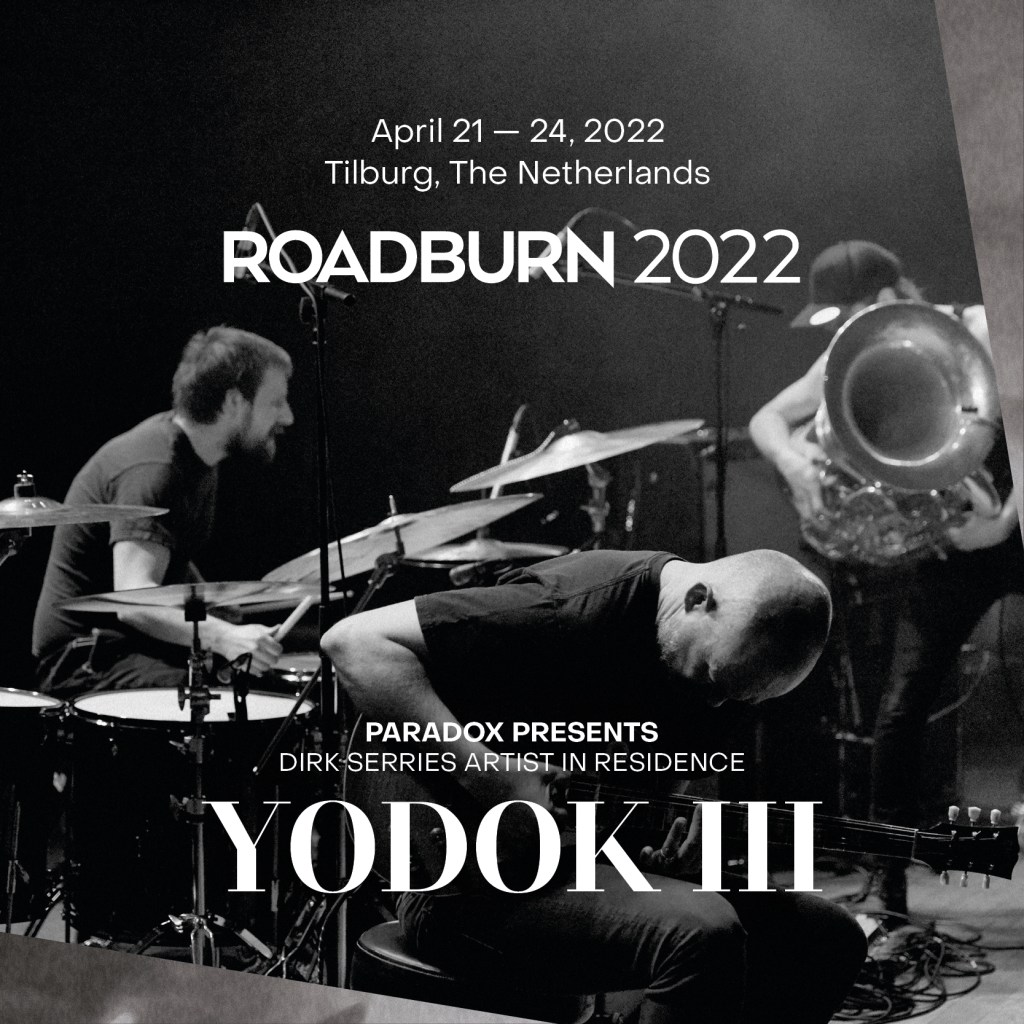
APRIL 22. All three members of YODOK III will come together for a performance on the Friday – bringing together this improvisational ensemble in an intimate setting that is perfect to see them at the height of their powers. YODOK III is a band that thrives on the adrenaline of improvisation, and the interaction and momentum that it brings. Do not miss this special performance that is sure to be dynamic, engaging and truly transcendental.
APRIL 23. Saturday will bring a performance by TONUS – Dirk’s minimalist ensemble that has a constantly evolving line up (this performance will feature Martina Verhoeven on piano, Colin Webster on saxophone, and Tom Malmendier on drums alongside Dirk). Describing it as “an exercise in discipline and anticipation while controlling the clarity, sustain and effect of each single note played” – we can’t wait to experience TONUS in person. TONUS will perform a brand new piece that blooms outward from a piano-led focal point. As a counter to the electronic-driven work that Dirk is best known for, TONUS offers an acoustic equivalent, and an opportunity to fully immerse ourselves.
The grand finale of Dirk’s residency is the Martina Verhoeven Quintet. Dirk runs a record label, A New Wave of Jazz, which focuses on his quest for free improvised, avant-garde and free jazz music – this curiosity and passion shines through on the final piece of this puzzle. The quintet is built around the piano virtuosity of polymath and multi-instrumentalist, Martina Verhoeven. The assembled musicians – Dirk on acoustic guitar, Onno Govaert on drums, Gonçalo Almedia on double bass, and Colin Webster on saxophone will create a high tension, free improvisation performance led by Martina’s energetic and unique piano playing.
Label curator DIRK SERRIES got interviewed by JAZZ BLUES NEWS on being an improviser and ‘guitarist’.
photo by Jef Vandebroek.
Jazz interview with jazz guitarist Dirk Serries. An interview by email in writing.
JazzBluesNews.com: – First let’s start with where you grew up, and what got you interested in music?
Dirk Serries: – I grew up in Hoboken, a small town very close to Antwerpen (Belgium). As a young kid, I loved, and still do, movies and movie soundtracks. I listening to a lot of Ennio Morricone records back then. When one of those records skipped one day and got in a sort of lock groove, I got truly obsessed about it, it triggered my early fascination for repetition, loops and cycling structures. The beginning of all.
JBN: –How did your sound evolve over time? What did you do to find and develop your sound?
DS: – This has been a process of years and I still think it isn’t finished yet, and luckily so as this is essential to the growth as an artist. But definitely my own style of working with minimalism and cycling structures in the first twenty years came to completion after hours of hard work in the studio, finding and controlling the techniques to work with, whether with synthesizers or the electric guitar. Naturally over the course of these two decades, interests, fascinations and inspirations expand and grow, and therefor the process of learning and exploring continues.
JBN: – What practice routine or exercise have you developed to maintain and improve your current musical ability especially pertaining to rhythm?
DS: – Never have been found of rehearsals. I consider myself more as a sound explorer. Finding the right tone, sound and color for my instrument is way more essential to my ability as a performer than to learn playing techniques on the guitar. I mean the techniques come naturally by trial and error. But the sound is so vital for myself to feel comfortable with the guitar, knowing that I have a solid tone which is diverse and compatible with my own style of playing or where I want to go during the improvisation. Rhythm has actually never been a relevant part in my playing, don’t like the obvious tempo of rhythm so here the choice of whom you work with is vital to this. My favorite drummers are those who think in abstraction and work around the notion of being trapped in a full-on 4/4 or repetitive groove. Never say never but I don’t see myself being a rhythmic guitarist.
JBN: –How to prevent disparate influences from coloring what you’re doing?
DS: – I think it’s impossible not to be influenced by something or somebody, considering how rich and full our musical history is. The trick is not to copy but use that influence to your own benefit, to apply that admiration in order to create your own specific style and way of making and playing music. This is of course the hard way but definitely the most rewarding one.
JBN: –How do you prepare before your performances to help you maintain both spiritual and musical stamina?
DS: – I used to have a strict regime when I was still working with structured and scored music, to the degree of being a perfectionist and control-freak. However, this ruined completely the pleasure of creating and performing. Discovering my own ability to improvise and avoid any kind of strict preparation, made me re-discover that enjoyment, the beauty of instant composing by improvisation. The thrill of creating together from scratch without having any rules or prepared structures is just a blessing and an experience that goes beyond any of my previous works, no matter how successful they were and still are.
JBN: –What’s the balance in music between intellect and soul?
DS: – For me personally music comes from the heart, hardly any conceptual background or motivation. Of course, you do think about visualization, on how to present your musician and with whom you want to collaborate but never liked the idea of attaching my music to an intellectual concept. Always felt and still do that such context would only diminish the spontaneity.
JBN: –There’s a two-way relationship between audience and artist; you’re okay with giving the people what they want?
DS: – Here too I personally don’t think about it too much before, during and after concerts. For me the essence of playing live and collaborating on the spot with fellow musicians is the main priority, the goal and the thrill of the live creation. If audiences are willing to go along with us in this adventure, great and of course you do get a boost when you hear now and then an ecstatic shout from in the audience. But within the free improvisation, I feel, it’s about that live momentum, communicating and creating together and I can only hope people will follow us in this quest.
JBN: –Please any memories from gigs, jams, open acts and studio sessions which you’d like to share with us?
DS: – I don’t think I can. Of course, you’ve concerts where everything works but I firmly believe that every live concert or studio session is essential to whom you are and how this will reflect on what follows next. None of the concerts I’ve done I take for granted but enjoy every second of it.
JBN: –How can we get young people interested in jazz when most of the standard tunes are half a century old?
DS: – What surprises, even disappoints, me is that the younger generations hardly go on a search to discover music which might appeal to them. I feel also that music in general has devalued to a level where it’s just part of the fabric, a form of superficial entertainment. Naturally you do have genres which are solely for that purpose but we’re talking here about (free)jazz, classical music, avant-garde, etc. and therefor it really blows my mind that people just don’t have the interest/motivation anymore to go out and discover new things, like the time when you went to a record store to search for intriguing music. Also, it really shocks me when concerts these days are just moments where people come together to socialize and not to really experience the magic of music, hence all the irritating talking of people during. Luckily in the free impro scene audiences are very attentive, it seems that this movement still draws the right people and perhaps it’s the degree of difficulty that selects and invites.
JBN: – John Coltrane said that music was his spirit. How do you understand the spirit and the meaning of life?
DS: – True. I do experience this the same way. Not religiously but music is part of my DNA, this is I live and breathe. I can’t think another way of how to live my life, to be honest. Naturally over the course of your life you do need to adjust here and there the degree on how far you led music take over, and sometimes you do need to take a step back as operating in the music business – no matter how independent or small the scene is, it’s a pretty hard and by moments very frustrating job. But the magic of music itself each time brings me back to where it pleasantly dominates my life. But honestly it’s sometimes quite Kane and Abel.
JBN: – If you could change one thing in the musical world and it would become a reality, what would that be?
DS: – That it would be less about money and more about integrity and the focus on the art itself. This way I firmly believe that way more interesting artists, musicians and bands will get a chance to introduce their music to the public. Now it’s all about the same usual suspects and what brings in the money.
JBN: –Who do you find yourself listening to these days?
DS: – I always had an eclectic choice in music and still do, like to mix up the styles I listen to daily. But there’s never a day that passes by without listening to one or two favorite albums from my childhood. I grew up with post-punk and new wave. But also, classical music and jazz are permanent in my playlists.
JBN: –What is the message you choose to bring through your music?
DS: – Let me be so free to quote writer Guy Peters: “Improvising musicians may or may not be overtly political but they subscribe to a set of values (not matter how ‘free’ the music sounds) and fundamental issues that somehow have become mutually exclusive with those of an economy that mainly serves itself. Mutual respect, unconditional trust, an open attitude, self-reliance, creation, invention, support and letting yourself be heard. These are the key ingredients of free music. At the same time these are the qualities that leaders who frown upon the arts, regard with suspicion, just like they do with every unruly voice.” Culled from his liner notes from ‘Obscure Fluctuations’ by John Dikeman, Steve Noble and myself for the TROST Records label. That says enough, me think.
Belgium’s JAZZ & MO magazine just reviewed JOHN EDWARDS & DIRK SERRIES’ ‘Melancholia’ album in their latest printed edition. The album is available from our store and on bandcamp.
“In zijn treffende hoestekst roept Guy Peters een interessante vraag op : het album heet Melancholia maar Peters zelf hoort vooral ongebreideld speelplezier. De vitaliteit van het duospel en de zucht naar avontuur zijn onmiskenbaar, dusdanig zelfs dat melancholie zo’n beetje het laatste is waaraan je bij deze muziek denkt. In elk geval is de plaat een ontmoeting tussen twee verwanten die elk uit een hoek van de experimentele jazz komen, en tussen twee instrumenten die net zo goed verwant maar erg verschillend zijn. Het woord experimenteel is hier zonder meer op zijn plaats. Dit is muziek waarvan de uitkomst niet op voorhand vaststaat, muziek die gebeurt. De koers wordt al spelende bepaald. Naar mijn idee mondt die aanpak op deze cd vooral uit in een onderzoek naar de textuur van klank. Er zijn meerdere momenten waarop het duo verrassende en soms zelfs overrompelende samenklanken vindt, en in de tussentijd wordt gezocht. De klankrijkdom is een ding, maar als luisteraar deelgenoot of zelfs medeplichtig mogen zijn in dat proces is toch de grootste sensatie” Jazz & Mo – Belgium
TOM JACKSON & COLIN WEBSTER’s THE OTHER LIES gets a fine review on Canada’s JAZZWORD by Ken Waxman. The album is of course still available from our store and on bandcamp. BANDCAMP is by the way waiving their revenue shares once again so that every penny goes directly to the musicians themselves. We’re offering you a 35% on individual digital or physical releases and a 60% discount on the full digital catalog. Thank you for your support !!
“The nub of linearity also occasionally peeks through the overblowing and segmented tones that make up The Other Lies. Jackson who has been part of The Apartment House and Webster who plays with Daniel Thompson and others, use every part of their respective instruments to source new and unique textures. Yet by the time they reach the concluding “VI” track, near classic textures are heard among clarion vibrations from the clarinet and resonating low pitches from the baritone saxophone. This confirms that linear harmonies and gentling balance are also present. Otherwise what lies in The Other Lies are mini essays in extended techniques with shrill and staccato clarinet lines butting up against alto or baritone tongue slaps, continuous blowing and split tone fragmentation. A few fowl honks suddenly increase the tempo in parts, and brief silent interludes prolong the sound descriptions. “I” sets up the improvisations at greatest length, starting with both overblowing in double counterpoint at great length. Breaking apart into altissimo clarinet squeals and grainy alto saxophone scoops and split tones, Webster soon joins Jackson at the highest reed pitches. Throwing the connective ostinato back and forth, the two reach a climax of harder, heavier and more segmented vibrations.”




 A New Wave Of Jazz
You must be logged in to post a comment.