The latest episode of the outstanding US radio show of Fred Kellogg on KAOS Olympia 89.3FM (Olympia, WA. USA) contains another fine collection of music we released on our label and music of musicians, affiliated with our label. Thank you, Fred, for the wonderful support.
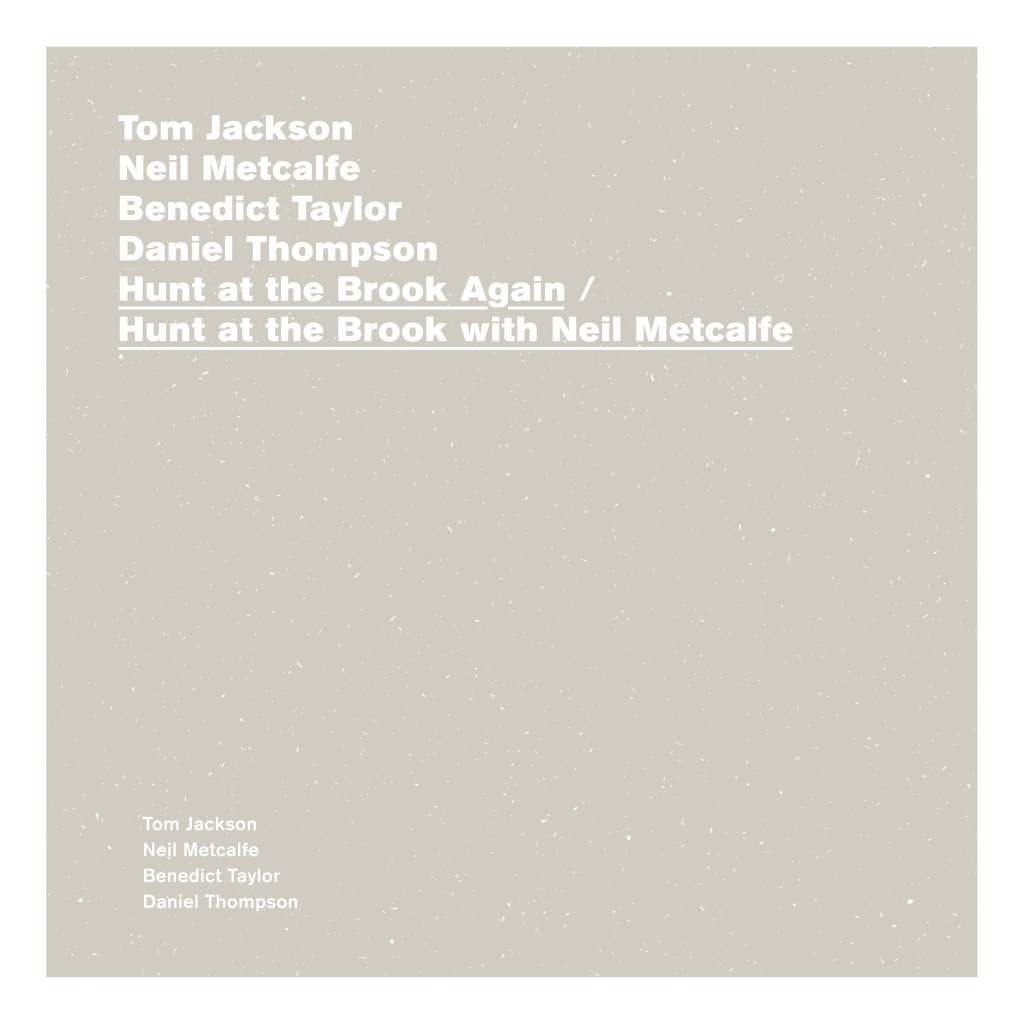
A lovely review by Eyal Hareuveni for the SALT PEANUTS webzine of HUNT AT THE BROOK AGAIN/HUNT AT THE BROOK WITH NEIL METCALFE.
“The double album Hunt at the Brook Again / Hunt at the Brook with Neil Metcalfe features Thompson in a trio in the first album with clarinetist Tom Jackson and violist Benedict Taylor, recorded at Stamford Brook in London in April 2019, and in a quartet in the second album, with the addition of veteran flutist Neil Metcalfe (known for his ongoing work with Paul Dunamll and the London Improvisers Orchestra), recorded at the same location a month later. Engineer Dave Hunt captured both sessions. The album’s title also refers to the first recording of the trio of Jackson, Taylor and Thompson, Hunt at the Brook (FMR, 2015), recorded at the same place, and by Hunt.
The trio brings a chamber sensibility to free improvisation and suggests a delicate and introspective exchange of ideas. These six improvisations flow organically and are much more relaxed and playful, rich with extended techniques, and often create a hypnotic and poetic, collective sound painting, as Guy Peters observed in his liner notes. These improvisations also balance the joyful spontaneity of the moment with the sensibility of instant composition. The four quartet improvisations introduce an intense and restless, risk-taking dimension to the intimate and chamber dynamics of the trio but the quartet finds its balance immediately. These improvisations create a collective tapestry of ideas and gestures, again, as complex compositions, with pure lyricism, especially on the third improvisation, and surprising elegance.” Salt Peanuts – Norway
UK’s MUSIQUE MACHINE just reviewed our 2023 release of HUNT AT THE BROOK’s double disc. This double album unites DANIEL THOMPSON, TOM JACKSON and BENEDICT TAYLOR again but also expand to a quartet with flutist NEIL METCALFE. This release is available through our bandcamp store. Thanks to Musique Machine for the publication.
“Here’s a two-CD set bringing together two different improv sets, and as it appears on Belgian-based New Wave Of Jazz, it sits at the more abstract, shifting, at points fairly visceral side of the improv genre. Both sets here were recorded at Stamford Brook in London in April and May of 2019- not sure if this is a small venue or studio, as doing an internet search didn’t seem to bring up much aside from the Tube station. Both sets were also recorded by one Dave Hunt- so hench the release’s Hunt At Brook title. So, the first set/ disc is from April and features the three-piece of Tom Jackson – clarinet, Benedict Taylor – viola, and Daniel Thompson – acoustic guitar- who offer up six tracks. We go from “Second Improvisation” which is the second longest track here at just over fourteen and a half minutes. It opens with a blend of dark plucked/ angular guitar that is edged by sourly simmering string tone & descending horn sustain. We then move from a blend of more rapid and playful clarinet, dating guitar stutt, and seared viola sipes. Onto counterbalances of sawing ’n’ baying sting work, which are shifted by exuberate horn playing. “Fourth Improvisation” slides in at the eight-and-a-half minute mark- opening with a very manic blend of darting horn piping, stop-start guitar pluck ‘n’ scrub, and searing ‘n’ swooping viola. Around the mid-way point, things become less demented/ more spaced with shifting horn wavers, and smaller compressed scrubs ‘n’ shifting neck fiddles- though things start to get manic again fairly soon. The second set/ disc is from May- featuring Tom Jackson – clarinet, Neil Metcalfe – flute, Benedict Taylor – viola, and Daniel Thompson- acoustic guitar. We open with the nearing sixteen & half minutes of “First Improvisation” which moves between a mixture of warbling horn haziness and malevolent pick ‘n’ pluck. And higher pitch horn fleeting’s meet vigorous string saw ‘n’ grate. “Third Improvisation” slides in just over the eleven-and-a-half minute mark- moving drifting horn bay & darting pick. Onto more flighty blend horn flight ‘n’ warble, meets manic saw & scrab. Through sour whistling & forlorn twang. The disc is finished off by “Fourth Improvisation” which is just over the four-minute mark- this is a decidedly swift & urgent blend of manic warble, fitful pluck, and jarring saw. Both discs here are rewarding- with a nice amount of shift & dart about the improvising. Though I’d say the second disc stood out most to me with its even balance of string and wind instrumentation, as I found the general pull/ shift of these tracks slightly more engaging.” Musique Machine – UK
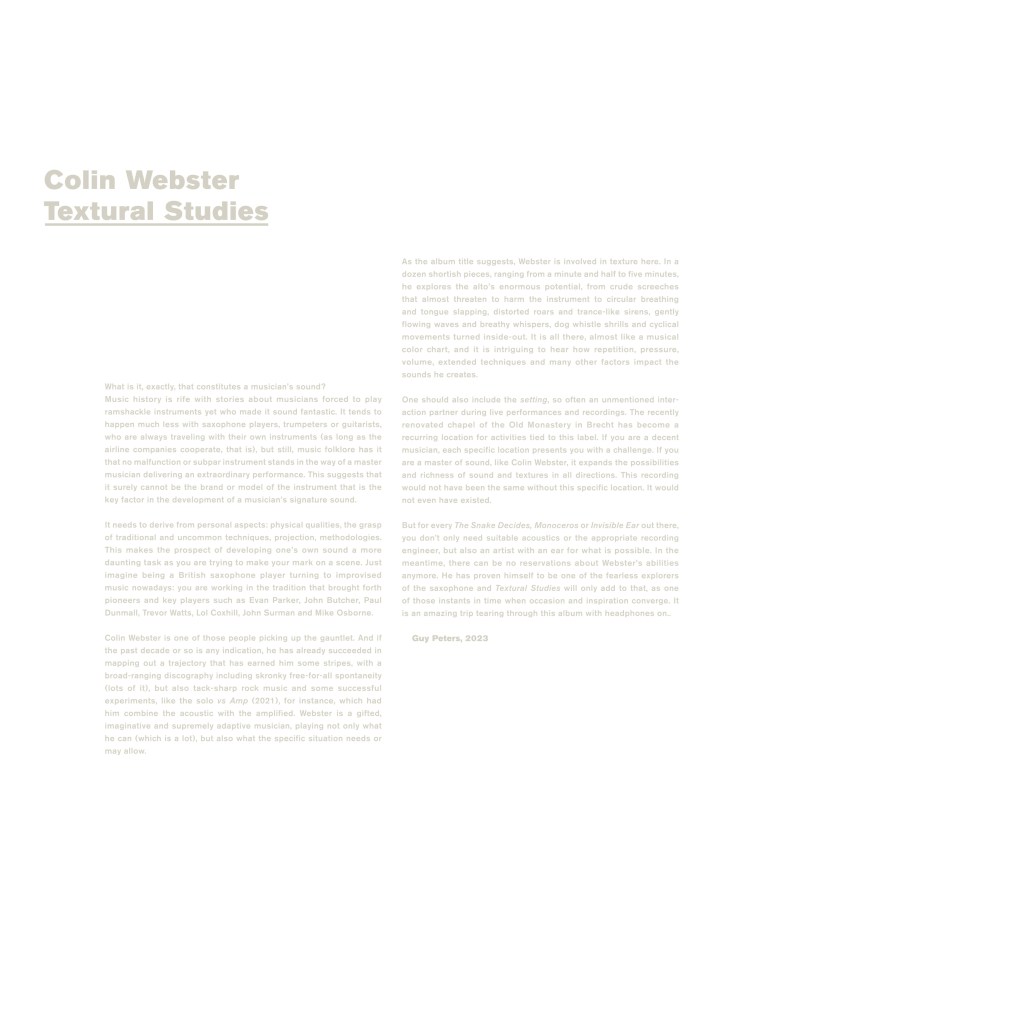
SPONTANEOUS MUSIC TRIBUNE (Poland) just reviewed COLIN WEBSTER’s TEXTURAL STUDIES vinyl release. The album, limited to 100 copies black vinyl, is available here.
“Nasz ulubiony brytyjski saksofonista popełnił już wiele płyt solowych. Grywał na nich zarówno na barytonie, jak alcie, i wydaje się, że zeksplorował wszystkie dostępne światu techniki preparacji instrumentu dętego, drewnianego. W najnowszych studiach nad teksturą dźwięku – tu altowego – muzyk stawia na pewną dramaturgiczną prostotę. Webster nie tyle pracuje tu nad brzmieniem, ile bawi się formą. A efekt jest co najmniej doskonały. Pierwsza i czwarta improwizacja, to zdaje się ta sama bajka – zwierzęcy ryk saksofonu na gęstym pogłosie, konsumujący mięsisty wydech i chwile strwożonej ciszy. W drugiej opowieści narracja dla odmiany sprawia wrażenie niezwykle lekkiej, niczym łabędzi śpiew o poranku, formując się w dron sycony oddechem cyrkulacyjnym. W trzeciej części tańczą gołe dysze, zaś w piątej znów wita nas oddychający, tu nieco melodyjny dron. W kolejnych odsłonach słyszymy świt zimnego powietrza dobywający się przez dziurkę od klucza i syrenę statku parowego – rodzaj leniwego drona w wysokim rejestrze, który łapie rezonans. W części ósmej muzyk zbliża do granicy hałasu, kreując niemal folkowo brzmiący skowyt. W kolejnych utworach dostajemy rezonującą porcję melodii, rodzaj ceremonialnej zabawy w dźwięk i ciszę, wreszcie dronową post-kołysankę, która przypomina borowanie zęba. Finałowa, dwunasta improwizacja także przyjmuje formę drona – tu definitywnie pożegnalnego, tęskliwego, rozkołysanego, ale nie sennego.” Spontaneous Music Tribune – Poland
Thanks to Eyal Hareuveni for writing this lovely review on COLIN WEBSTER’s TEXTURAL STUDIES release on A New Wave Of Jazz. A beautiful black vinyl on 140 gram, limited to 100 copies so do get that copy over here.
Textural Studies is the seventh solo album of prolific British sax player Colin Webster, focusing on the alto sax. These focused studies allow Webster to keep investigating his rich sound, as a physical entity shaped in distinct acoustics, space and time, often an abstract and noisy one, and as an evolutionary, elastic ethereal ingredient within loose textures while employing, obviously, extended breathing techniques. The album was recorded, mixed and mastered by Webster’s close comrade, Belgian guitarist Dirk Serries at Oude Klooster, a recently renovated old chapel in Brecht, Belgium, in February 2023, and released by Serries’ label, A New Wave of Jazz as a limited edition of 100 vinyl plus download option. Webster is well versed in the pioneering solo works of British sax players such as Evan Parker, John Butcher, Paul Dunamll, Trevor Watts, John Surman and Mike Osborne but has his way of structuring and deconstructing repetition, pressure, volume, percussive elements and other extended techniques through twelve concise and arresting pieces.


You must be logged in to post a comment.