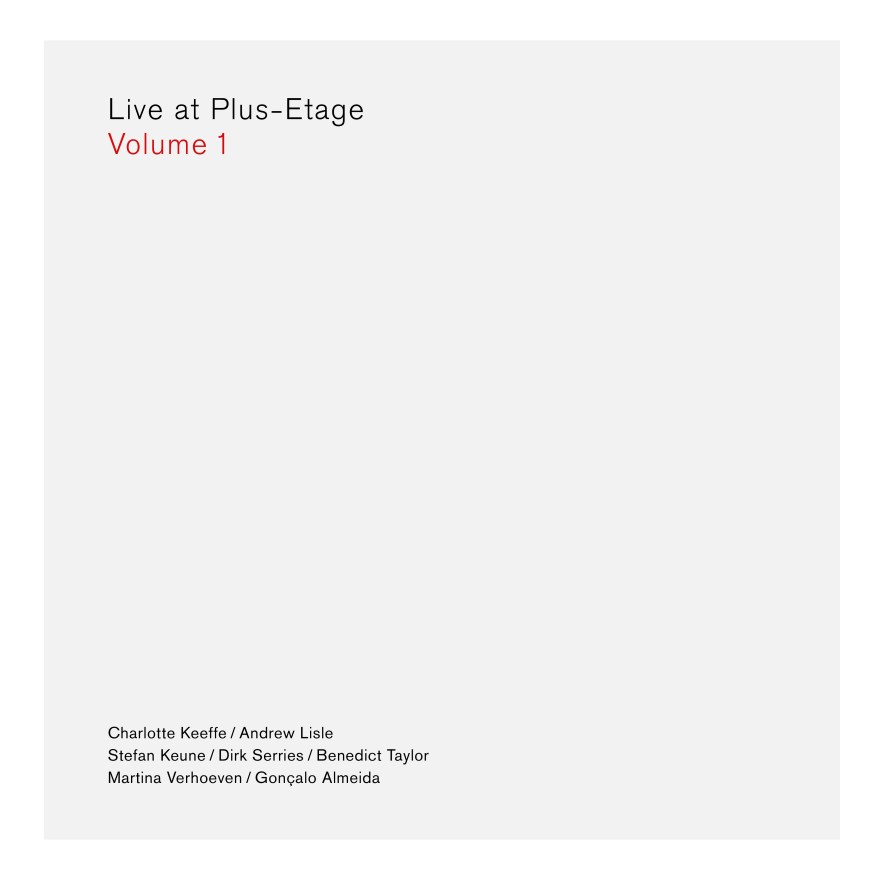
Live At Plus-Etage

KEN WAXMAN, one of the great reviewers and a person who supports and believes in the music we produce, just published his review of LIVE AT PLUS-ETAGE, our 3cd compilation that covers 3 different concerts, in our label series, at the fantastic Plus-Etage venue in Baarle-Nassau (The Netherlands). The album is available here.
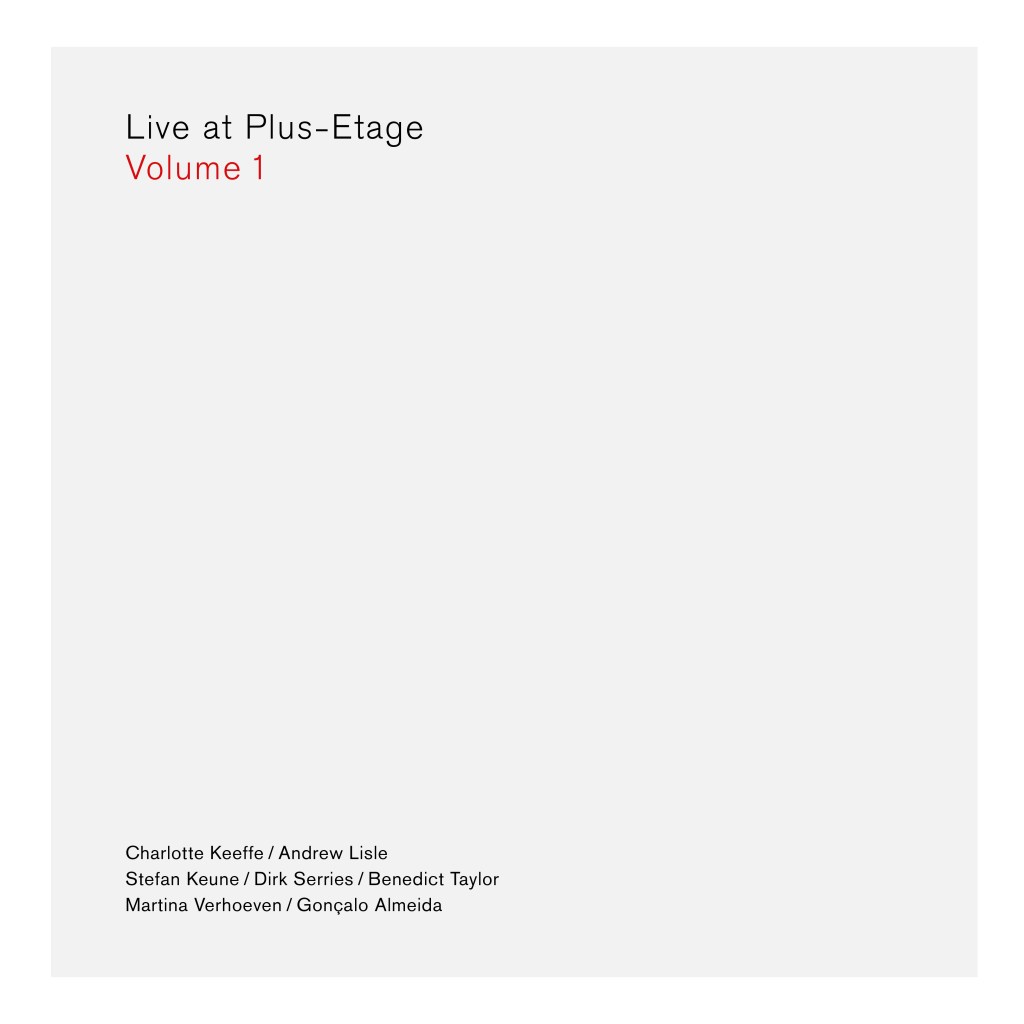
“…Instrumental virtuosity, but expressed in a minimalist fashion is what distinguishes next generation of improvisers as the three-CD set Live at Plus-Etage Volume 1 (New Waves of Jazz nwoj 0060) demonstrates. The duos of trumpeter/flugelhornist Charlotte Keeffe and drummer Andrew Lisle from the UK; double bassists Martina Verhoeven from Belgian and Portuguese Gonçalo Almeida; and the trio of Belgian guitarist Dirk Serries, UK violist Benedict Taylor and German saxophonist Stefan Keune show that collaborating improvisers are as international as always and with one CD for each configuration, all have space to display what they can do. Except for an unaccompanied interlude of cymbal vibrations and drum rumbles during the second and concluding set Lisle mostly limits himself to claves-like resonations, bass drum plops and rim shots accents. That way the figurative spotlight shines on Keeffe’s brass prestidigitation. Emphasizing non-valve movement breaths, broken-chord smears, aviary-like peeps, throaty squalls and tremolo brassiness her spikey asides don’t preclude portamento affiliation however. As much as her tongue jujutsu, swerves and swallows exposing usually unexplored inner portions of her horn’ lead pipe for unexpected tone variations each time sections are repeated, passages of near-lyrical melodies and feathery brassiness are also heard. Vaguely related to the “William Tell Overture”, a riff that gallops through her improvised variations during first set is sounded again before the concert is completed adding a connective leitmotif. Contrasting arco and pizzicato techniques characterize the Verhoeven/Almeida single track as they constantly switch roles with buzzing spiccato tones from whistling screams to woody rubs met with repeated strums and lowing stops that sometimes approximate a washtub bass’ single-string thud. More sophisticated than that primitivism, the sequences include interludes of ratcheting slices, string pops, vibration of implements placed among the strings, and heightened pressure that suggests the bow is cutting through the instruments’ wood finish. During the penultimate section bell shakes and ratcheting whirs add novel patterns as stropped strings expose the highest pitches and col legno pops the lowest. Eventually billowing arco strokes are heard from both, which gradually fade from staccato to connective. Interestingly enough the two improvisations from three players seem most separated. The transformative program includes multiple instances of almost complete silence, while, except near the conclusion where Serries unleashes a string of mandolin-like twangs, the guitarist restricts himself to connective comping. Emphasis is on how Keune’s often singular irregularly vibrated split tones and narrowed peeps meet Taylor’s equally jagged bow slices, stops and sul tasto pressure. Although the two confront one another head on at intervals, fury among the calm is commonly given over to sequential timbral elaboration. Emphasizing melodic and rhythmic ambiguity, alternating expressions include the saxophonist’s dexterous bubbling trills, tongue stops and vibrated tone scoops, while the violist’s strained glissandi and squeaky rests are as distinctive as they are numerous. Preceding and expanding on the guitarist’s one showcase, linear advancement is emphasized in a climatic motif as pointed string scrubs, reed whorls and finger-style guitar chords are patched together. Sometimes exemplary creativity must be expressed in larger than usual forms and these multiple sets prove that truism.” Jazz Word – Canada
HAPPY FESTIVITIES

We slowly heading toward the end of one year and the beginning of another one. From our headquarters, we wish everyone a joyful week of however you spend your holidays. We hope we can continue with our vision in 2024 but for now, here’s a toast to what we achieved this year, bringing you an array of incredible music, fantastic artists, and great people closer to your home and ears. Thank you for all your support !

LIVE AT PLUS-ETAGE

Belgium’s JAZZ & MO jazz magazine just published a brief (slightly inaccurate) review of our LIVE AT PLUS-ETAGE release but still grateful for the exposure. This fantastic collection of live performances is available through our bandcamp store.

“PlusEtage is een kleine venue in Baarle-Nassau, Nederland, binnen een multifunctioneel gebouw, waar vrijwilligers en musici de cultuur van de vrije improvisatie sterk houden. Zoals de titel zegt, is dit het eerste volume op drie cd’s van een reeks concert-captaties. Interessante concerten met diversiteit, die de werking van de Plus-Etage schetsen. Een mooie collectie voor de liefhebbers en benieuwden” Jazz & Mo – Belgium

VITAL WEEKLY REVIEWS

Reviews of COLIN WEBSTER’s outstanding new solo album are slowly arriving, here’s a really fine one on VITAL WEEKLY. Order here.

“There are exceptions, but the saxophone isn’t my favourite instrument. Often, it becomes a nerve-wracking jazz wail, and that’s not for me. As said, there are exceptions. An early one is the split cassette by Eyeless In Gaza and Lol Coxhill; I like Borbetomagus. This new album by Colin Webster is another one that I enjoy. He plays the alto saxophone in the chapel of the Oude Klooster in Brecht, Belgium, with a wooden ceiling, and Dirk Serries captured the sound using various microphones. The title of the album is program here, studies in textures. There are twelve short pieces of saxophone music, each on a more sustaining note, but not exclusively. Webster offers a texture rather than a drone rather than a succession of quick notes. A texture aiming not always to please, as Webster uses considerable force here. That’s another thing I like about this record; there is some pretty
intense noise music here, a brutalist approach, and that’s something I enjoy. And, of course, acoustic noise is not something you hear every day. Webster combines this acoustic noise with an unmistakable minimal touch. Many pieces are about circular breathing, repeating phrases all the time. Here, this album shines most for someone who is only mildly interested in improvised music but whose heart goes to minimal music. The recording is crisp and clear; those saxophone sounds bouncing around in this hall add weight to the recording. It might not be your typical improvised music record, which is, perhaps, a disappointment for some, but for me, a delight. A particularly strong record.”

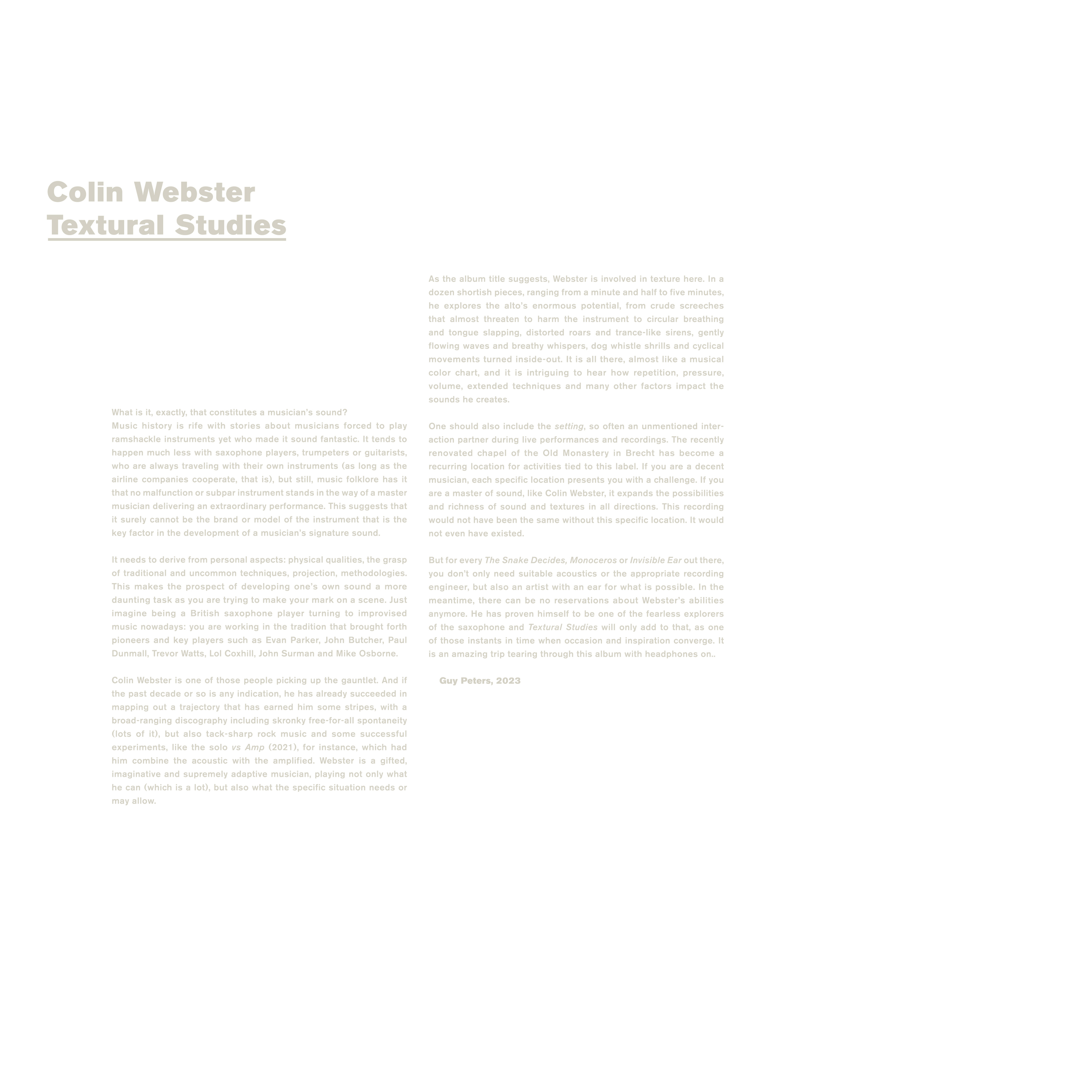
COLIN WEBSTER’s TEXTURAL STUDIES

On December 9th we officially released the magnificent new solo album of COLIN WEBSTER. TEXTURAL STUDIES was recorded at the Oude Klooster chapel in Brecht (Belgium), the village where the label headquarters are located. The album on limited 140 gram vinyl is available here.

JAZZ EN ZO just reviewed his album and it’s lovely !! Thanks to Georges Tonla-Briquet.

“Een nieuwe soloplaat van de Britse saxofonist Colin Webster onder een gepaste titel. ‘Textural Studies’ is inderdaad een oefening in het experimenteren met mogelijke en vooral de meest bevreemdende klanken van de altsaxofoon.

Een oerkreet op de saxofoon als aankondiging van wat gedurende iets meer dan een half uur zal volgen. Colin Webster laat geen twijfel bestaan. Hij kreeg op 9 februari 2023 carte blanche in de opnamelocatie Oude Klooster in Brecht en gebruikte die optimaal. Wie zijn werk kent op het label en ook daarnaast, spitst de oren en zet zich schrap.

Niet dat Webster van begin tot einde de luisteraar confronteert met een verstikkende decibelstorm. Het wiegende ‘A.II’ is gebaseerd op een organische loop getekend door rituele zeggingskracht. ‘A.III’ is zijn moment om een percussieve passage in te lassen. Het blijft Webster natuurlijk, de muzikant die houdt van contrasten. Dat betekent stil versus luid, hoog (‘B.II’) tegenover laag (‘B.I’) of nog kortstondige uithalen (‘A.IV’) in juxtapositie met adembenemende lange lijnen (‘A.V’, ‘B.VI’). 

De nodige experimenten en expliciete (adem)technieken ontbreken evenmin (‘A.VI’). Bij dit alles hanteert hij zijn persoonlijke stilistische normen en zet zich toch wel duidelijk af tegen geldende conventies. Een zoektocht naar de mogelijke en vooral ook onmogelijke tessituur van zijn instrument. 

Ter verduidelijking: de saxofonist vermijdt titels en verkiest een logische nummering verdeeld over beide plaatkanten. Een ontluisterend hoorspel annex academisch kantje en helemaal geschikt voor de aficionados. “